
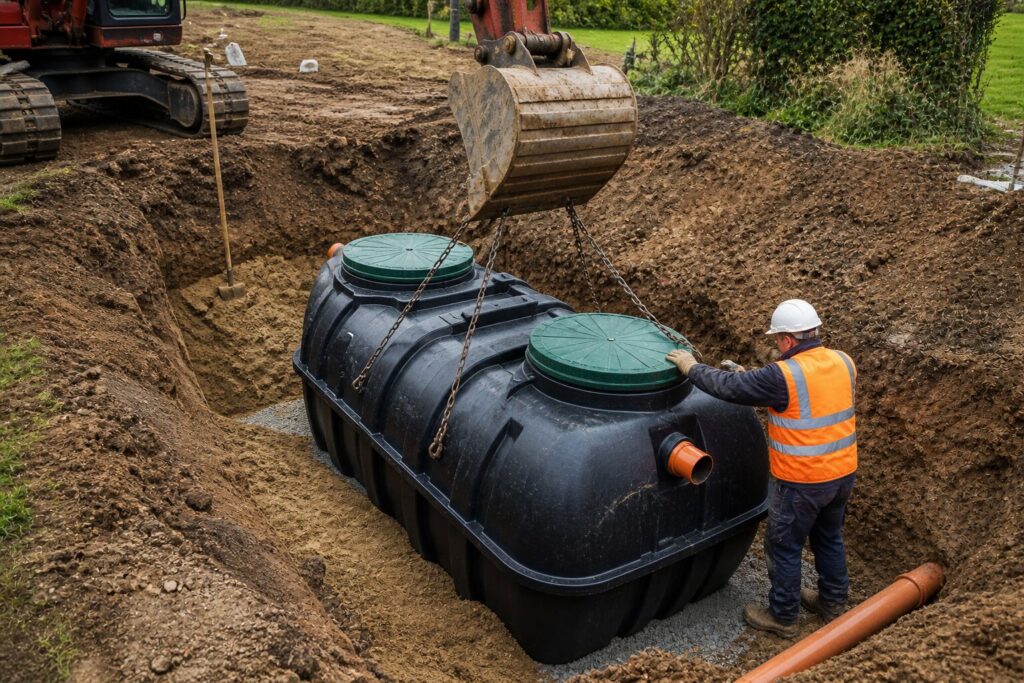
Do You Need Planning Permission for a Septic Tank in Hereford?
If you’re planning to install or replace a septic tank in Hereford, one of the first questions is simple: do you need planning permission?
The short answer is yes in many cases. But it depends on what you’re doing. A brand new system is treated very differently from replacing an old one.
There’s also more to it than planning alone. Building Regulations and Environment Agency rules play just as big a role, and in some cases, they matter more.
This guide breaks it down in plain terms so you know exactly where you stand before starting any work.
The short answer
Before looking at the warning signs, it helps to understand how a cesspit works and why problems can develop faster than expected.
How a cesspit works
A cesspit is a sealed underground tank that collects all wastewater from your property. This includes water from toilets, sinks, showers and appliances.
Unlike a septic tank, there is no treatment process. Nothing is broken down or filtered. Everything stays inside the tank until it is removed.
Why capacity is limited
Because there is no treatment, a cesspit will fill up much faster than other systems. Its capacity is fixed, and once it reaches that limit, there is nowhere for the wastewater to go.
This is why regular emptying is essential. Missing a scheduled empty can quickly lead to the tank becoming full.
Why missed emptying causes urgent problems
Most cesspit emergencies are caused by one simple issue: the tank has been allowed to fill too much.
When this happens, you can start to see:
- slow drainage inside the property
- pressure building in the pipes
- early signs of overflow
When planning permission is required
If you are installing a new septic tank or sewage treatment plant, you will usually need planning permission.
This is especially common in rural parts of Hereford where properties are not connected to the mains sewer. In these cases, the drainage system is part of the overall development, so it needs approval.
Herefordshire Council supports alternative sewage systems on suitable rural sites, but that does not remove the need for permission. Each proposal is still assessed based on location, ground conditions, and environmental impact.
A typical example would be a new-build home in the countryside. If there is no access to mains drainage, the septic tank or treatment plant must be included in the planning application.
Replacing an existing septic tank
Replacing an old septic tank is treated differently.
If it is a like-for-like replacement in the same location, you may not need full planning permission. This is often the case for older rural properties upgrading outdated systems.
However, this only applies if nothing significant changes. If you alter the size, move the system, or change how it discharges, planning permission may be required.
Even without planning, the new system must still meet current standards. That includes Building Regulations and discharge rules.
Changing or upgrading a system
If you are upgrading a septic tank to a sewage treatment plant, the rules can change again.
This often happens when an existing system is no longer compliant, especially if it discharges into surface water.
Because this type of upgrade can affect how waste is treated and discharged, it may require both planning permission and additional approvals.
Building Regulations you must follow
Why Building Regulations approval matters
Planning permission is only one part of the process. You also need to meet Building Regulations.
These rules apply to septic tanks, sewage treatment plants, cesspools, and drainage fields. They make sure the system is safe, correctly installed, and suitable for the property.
Even if planning permission is not required, Building Regulations approval almost always is.
What Approved Document H covers
Building Regulations for drainage are set out in Approved Document H.
This covers how wastewater systems are designed and installed. It includes things like tank sizing, drainage field layout, and how the system connects to the property.
The goal is simple. The system must safely handle waste without causing pollution or health risks.
Environment Agency rules you cannot ignore
Where your septic tank can discharge
One of the most important rules is where your septic tank discharges.
In most cases, it must discharge into the ground through a drainage field. This allows the soil to treat the waste safely.
Discharging directly into surface water like a river, stream, or ditch is not normally allowed for a septic tank.
These rules are set by the Environment Agency and apply across England.
Surface water vs ground discharge
There is a clear difference between discharging to ground and discharging to surface water.
- Ground discharge is usually acceptable if the system is designed correctly
- Surface water discharge is heavily restricted and often not allowed for septic tanks
If your system currently discharges into a ditch or watercourse, it may already be non-compliant.
When you may need a permit
You may need a permit if your system does not meet the general binding rules.
This can happen if:
- The discharge does not meet the required standards
- The system is in a sensitive location
- The setup is unusual or higher risk
In these cases, you will need to apply to the Environment Agency for permission to discharge.
Rules for existing septic tanks
Checking if your system is compliant
If your property already has a septic tank, you should not assume it meets current rules.
You need to check:
- Whether it had planning permission when installed
- Whether it has Building Regulations approval
- Whether it complies with current discharge rules
This is especially important if you are buying or renovating a property.
Older systems and key dates
The rules differ depending on when the system was installed or changed.
Systems installed before 1 January 2015 may not meet current standards. In these cases, it is worth speaking to Herefordshire Council for guidance.
You may not need to replace the system immediately, but you do need to understand your position.
What happens if it is not compliant
If your septic tank does not meet the rules, you may need to take action.
This could include:
- Upgrading the system
- Replacing it with a sewage treatment plant
- Applying for a permit
A common issue is discharge into surface water. In most cases, this means the system needs to be upgraded.
Local considerations in Hereford
If your property is in a rural part of Hereford, a septic tank or treatment plant is often the only option.
Herefordshire Council supports alternative sewage systems where mains drainage is not available. But each case is still assessed individually.
Things that can affect approval include:
- Ground conditions and soil type
- Distance from watercourses
- Property location and access
- Environmental impact
This is why a proper site assessment is usually needed before applying.
Real examples
New build with no mains drainage
A new home in the countryside will usually need:
- Planning permission for the drainage system
- Building Regulations approval for installation
The septic tank or treatment plant is part of the overall planning application.
Replacing an old tank at a rural property
If an existing tank is replaced like for like, planning permission may not be required.
However, the new system must still meet current standards, especially for discharge.
Tank discharging to a ditch or stream
This is a common issue with older systems.
In most cases, this setup is no longer compliant. The system may need to be upgraded to a sewage treatment plant or adjusted to discharge to ground.
Do you need a permit as well as planning permission?
In some cases, yes.
Planning permission and Building Regulations deal with the installation. But discharge is controlled separately by the Environment Agency.
You may need a permit if:
- Your system does not meet general binding rules
- The discharge is into surface water
- The site is environmentally sensitive
It’s important to look at all three areas together: planning, building, and environmental rules.
Get In touch
Getting this right early can save time, money, and delays.
Whether you are installing a new system, replacing an old one, or checking compliance, it helps to have clear advice from the start.
We can help with:
Site surveys and drainage testing
System design and installation
Upgrades to meet current regulations
Guidance through planning and approvals
Frequently Asked Questions
Do you always need planning permission for a septic tank in Hereford?
No. A new system usually does, but replacing an existing one may not, depending on the work involved.
Do septic tanks need Building Regulations approval?
Yes. All septic tanks and treatment systems must meet Building Regulations.
Can a septic tank discharge into a river or ditch?
No. It should discharge to the ground through a drainage field unless a compliant system and permit are in place.
What if my property already has a septic tank?
You should check that it has the correct approvals and meets current discharge rules. Older systems may need upgrading.
Who regulates septic tanks in Hereford?
Planning is handled by Herefordshire Council, while environmental rules are set by the Environment Agency.